How Far Back Does SSDI Back Pay Go for Washington Claims
Most people filing for SSDI expect back pay to start the day they became too sick or hurt to work. By approval day, some find they’ve lost five full months to a waiting period they never knew existed, and potentially a year’s worth to a retroactive cap that applies regardless of how strong their medical records are. Understanding how far back SSDI back pay can go means understanding a set of federal rules that run on Social Security’s timeline — not yours — and knowing exactly which dates those rules actually care about.
Four things shape your back pay: the onset date Social Security accepts, when you filed your application, the five-month waiting period the law requires, and a cap on how far retroactive benefits can reach before your filing date. Each one can quietly shrink the total. Russell & Hill helps Washington families understand these rules before a timing mistake costs them benefits they earned.

SSDI Back Pay Usually Starts Later Than People Think
How far back SSDI back pay can go depends on dates that Social Security — not you — controls. The sections below break down each one.
Your Back Pay Starts on Social Security’s Clock, Not Yours
Social Security does not start your back pay clock the day you stopped working. It starts it on the date the agency decides your medical evidence actually supports — and that date is routinely months later than what applicants report on their forms. Federal rules tie retroactive benefits to when entitlement conditions were officially established, not when your condition began in your own life. The practical consequence: a well-documented disability can still draw a later start date because records had gaps, treatment wasn’t consistent, or an adjudicator drew a different line through your medical history.
Same Diagnosis, Different Back Pay
Two people with identical conditions can walk away with very different back pay amounts. The reason comes down to when each person filed and how well their medical records support an early onset date. SSA research shows application timing varies widely by age, diagnosis, and whether someone kept working after onset. Filing later or having incomplete records pushes the benefit start date forward, shrinking the back pay window.
Four Dates That Tell You What to Expect
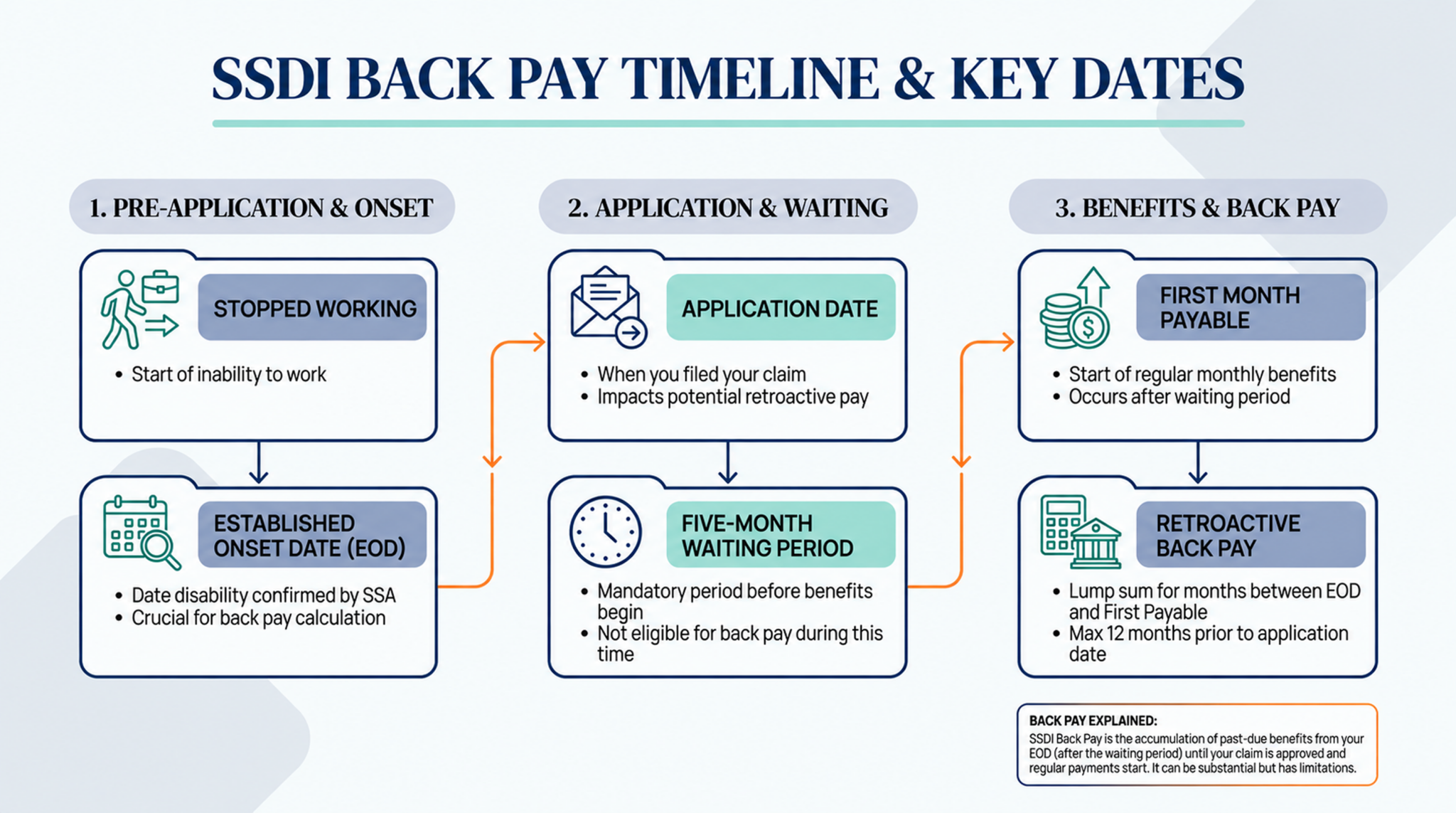
The clearest way to estimate your back pay is to line up four dates in order: when you became unable to work, the onset date Social Security accepts, your application date, and the first month benefits can legally begin. SSA’s disability rules confirm that the five-month waiting period begins after the accepted onset date, not after you file. Each of those dates shapes the final number on your check.
The Onset Date Controls the Back Pay Clock
What disability onset date does Social Security use to calculate SSDI back pay?
The date Social Security uses to mark the start of your disability, called the Established Onset Date, is the single most important number in your back pay calculation. It is not automatically the day you got hurt or the day your doctor said you couldn’t work. It is the earliest date the agency believes your medical evidence actually supports, and that distinction can mean the difference between months of back pay and none at all.
Here is the part that catches a lot of people off guard: what you believe your onset date to be and what Social Security will approve are often two different things. The agency is required to set the earliest onset date the evidence supports, but if your records have gaps, your treatment was inconsistent, or the documentation doesn’t clearly connect your condition to a specific period, the adjudicator may push that date forward. Every month the onset date moves later is a month of back pay you won’t see.
What actually moves the needle when Social Security evaluates your onset date:
- Medical records tied to specific dates carry the most weight. A treatment note from the week after your accident is worth far more than a doctor’s general statement written months later.
- Work history helps confirm when you stopped being able to work. If you tried to keep working after your injury and couldn’t, that pattern matters to the agency’s analysis.
- Consistent treatment notes show a continuous, documented story of your condition, which makes it harder for Social Security to argue your disability started later than you say it did.
- Your own statements about when symptoms began are considered, but they carry less weight than objective medical evidence without supporting records.
- Gaps in care can shift the onset date forward. If there’s a period where you weren’t seeing a doctor, Social Security may use that gap to justify a later start date.
When the onset date gets pushed even a few months in the wrong direction, real money disappears from your back pay. That is why the Russell & Hill SSDI back pay guide emphasizes getting this date right from the very beginning, not just at the appeal stage. Fighting for the correct onset date on appeal is absolutely possible, but the strongest position is building the evidence before the initial decision is made.
The Waiting Period and Retroactive Cap Limit How Far Back Pay Goes
How does the five-month waiting period affect SSDI back pay?
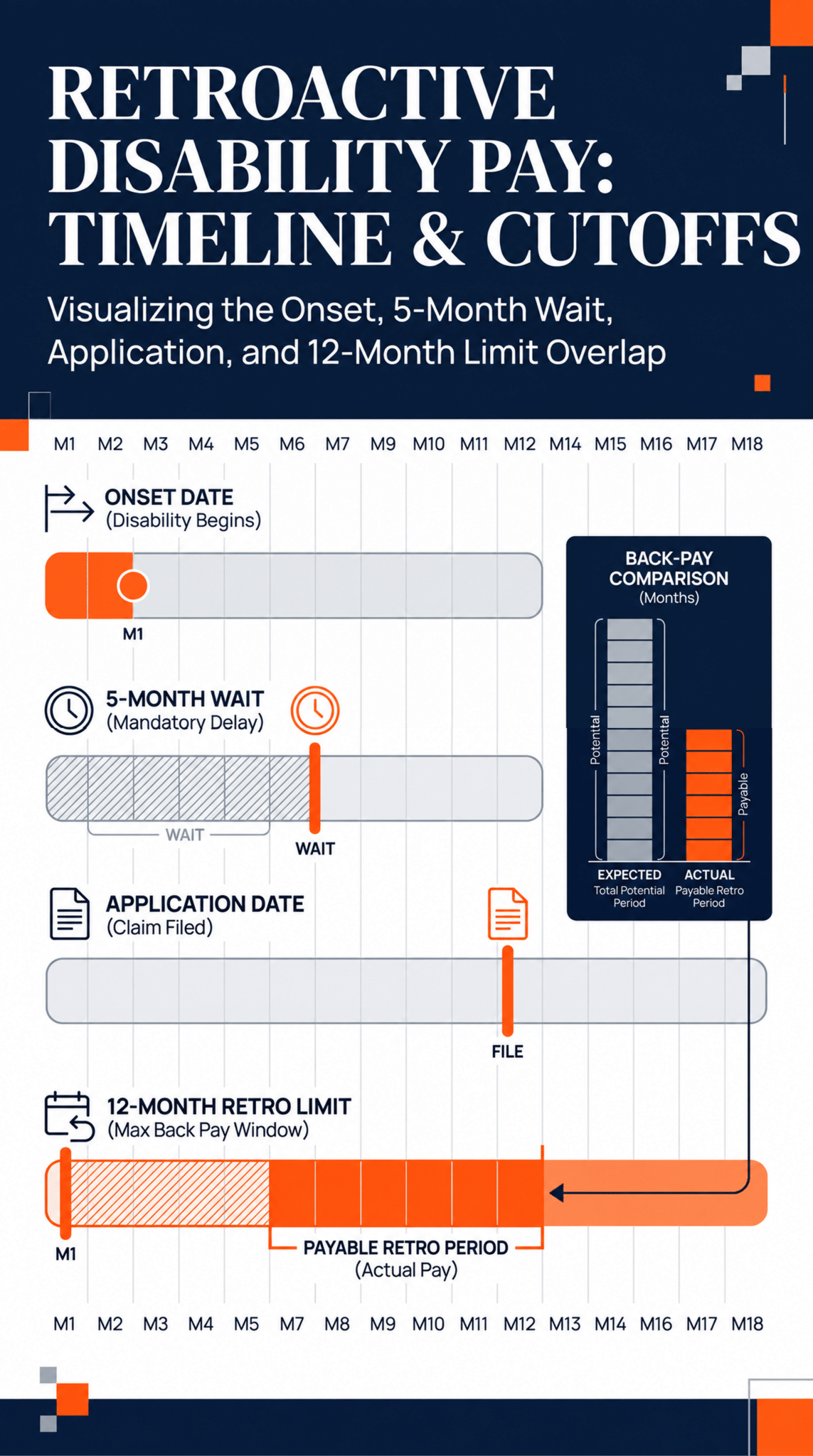
The five-month waiting period eliminates the first five full calendar months of SSDI benefits after your established onset date — no payment is made for that period, regardless of how severe your condition was. A second federal rule further limits how far back pay can reach: retroactive benefits are capped at 12 months before your application date, even when medical evidence could support an earlier start.
| Rule | What It Means | Effect on Back Pay |
| Established Onset Date | The earliest date Social Security accepts that your disability began, based on medical evidence | Sets the starting point for the entire back pay timeline; a later onset date shrinks the window |
| Five-Month Waiting Period | SSDI does not pay for the first five full months after the established onset date | Reduces back pay by at least five months regardless of when you stopped working |
| Application Date | The date you filed your SSDI claim with Social Security | Caps how far retroactive benefits can reach; filing later cuts off earlier months permanently |
| 12-Month Retroactive Limit | Benefits can be paid for up to 12 months before your application date if evidence supports it | Even strong medical evidence cannot extend back pay beyond this cap |
These rules stack on top of each other, which is why the final back pay number is almost always smaller than people expect. If your onset date is accepted as 18 months before your application date, you lose the first five months to the waiting period and potentially another month or more depending on how the retroactive calculation lines up, leaving far fewer months covered than the raw timeline suggests. Filing promptly and fighting for the earliest supportable onset date are the two most direct ways to protect what you’re owed. The Russell & Hill Spokane Social Security team works through exactly these calculations with Washington clients so there are no surprises when an approval finally arrives.
Common SSDI Back Pay Questions
When an SSDI approval finally arrives, the back pay amount is often the first thing people check — and the first thing that surprises them. The questions below address the timing issues that most often explain the gap between what people expected and what Social Security actually paid.
Why is my SSDI back pay less than I expected after approval?
Several rules can reduce back pay. The five-month waiting period eliminates those months entirely. If Social Security set your established onset date later than you believe your disability began, you lose every month between the two dates. Offsets for workers’ compensation or other government benefits can also reduce the final amount.
Does a denial and appeal change how far back SSDI back pay can go?
Your original application date stays on record through the appeals process, so a successful appeal can still reach back to that protected date. What changes is time. The longer an appeal takes, the more months accumulate between filing and approval — months that may eventually be covered if you win. Protecting that original filing date is one reason understanding disability qualifications in Washington before you file matters so much.
What records should you gather if you think Social Security used the wrong onset date?
SSA policy requires adjudicators to consider all available medical evidence when setting an onset date. Treatment records, ER visits, imaging results, and notes from treating physicians close to the date you stopped working carry the most weight. Employer records showing when you last worked and any statements from doctors about when your condition became disabling can also support an earlier onset date on appeal.
Can Social Security go back and change an onset date after approval?
Yes, through a process called reopening. If new or previously unavailable medical evidence shows your disability began earlier than the approved date, you can ask SSA to reconsider. There are strict time limits on reopening a decision, so acting quickly after an approval you believe is wrong is important. An attorney can help you evaluate whether the evidence justifies that request. Learn more about how Social Security defines disability and what that standard means for your timeline.
Get Clear Answers Before a Timing Mistake Costs You Benefits
Four rules — the accepted onset date, the five-month waiting period, your application filing date, and the 12-month retroactive cap — stack against each other in ways that consistently produce a smaller number than people expect. Each reduction is permanent. There is no retroactive correction once the window closes.
If your back pay came in lower than you expected, or you believe Social Security set the wrong onset date, Russell & Hill can walk you through exactly why — and what options are still open. When you call, you reach an attorney, not a case manager. That distinction matters most in these moments, when a wrong number on an award letter represents real money your family was counting on.